 Red Donut
The Jacket of Via Portese
$299.99
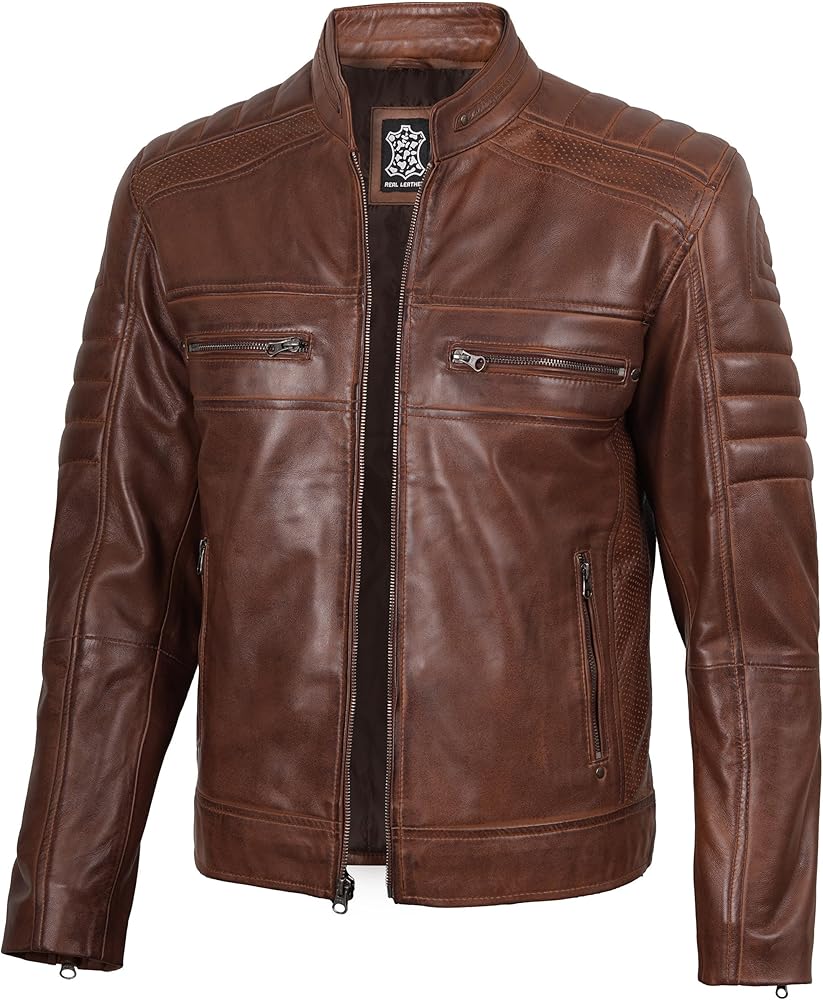
A Jacket with A Story
The leather hung limp on the rack like a forgotten promise, cracked and dulled by years of neglect. Marco almost walked past it—he’d seen dozens like it that morning at Porta Portese, Rome’s sprawling Sunday flea market where the discarded dreams of the city came to rest.
But something made him stop.
It was the shoulders. Even beneath the grime and the peeling surface, he could see the structure: wide, assertive, cut with a precision that spoke of another era. He lifted it from the rack, and the vendor—an old woman with silver hair tucked under a faded scarf—waved her hand dismissively.
“Five euro. It’s garbage. The leather is dead.”
Marco ran his fingers along the sleeve. The leather was nearly dead, brittle as autumn leaves in places, the lining shredded to cobwebs. But the bones were good. Beautiful, even. Someone had loved this jacket once, had worn it through the streets of Rome or Milan or some small town in the Tuscan hills. He could almost smell the cigarette smoke and espresso that had once clung to it.
“I’ll take it,” he said.
In his studio in Trastevere, Marco laid the jacket on his worktable like a surgeon preparing for an operation. Afternoon light slanted through the tall windows, illuminating the damage: splits along the elbows, collar worn to nothing, zipper long seized.
He’d been working in leather for twenty years, first as an apprentice to his uncle, then in the ateliers of Florence, and now here, in this sun-filled room where he created custom pieces for clients who wanted something no one else could wear. But this project was different. This was rescue. Resurrection.
He began with a bath—not water, which would destroy what remained, but a careful treatment with specialized oils, working them into the leather with patient hands, coaxing the material back to something resembling life. Days passed. The leather darkened, softened, began to breathe again.
Then came the real work.
Where the elbows had split, he didn’t simply patch—he cut geometric panels from a supple burgundy leather, contrasting sharply with the jacket’s worn black, creating an intentional asymmetry. On the right shoulder, where the leather had cracked beyond saving, he removed a section entirely and replaced it with a piece of cognac-brown leather, tooled with a subtle pattern of vine leaves, a nod to the Tuscan countryside.
The collar, too damaged to save, became an opportunity. He fashioned a new one from deep navy leather, standing rather than folded, giving the jacket a modern, architectural quality. Along the seams, he added hand-stitching in gold thread—tiny, meticulous stitches that caught the light.
For the lining, he found a vintage silk from a market in Prati, midnight blue printed with tiny stars, and sewed it in himself, every stitch deliberate. He replaced the broken zipper with heavy brass hardware salvaged from a 1960s motorcycle jacket.
But the final touch—the detail that transformed it from rehabilitation to art—came late one night when he couldn’t sleep. He took a thin strip of the burgundy leather and tooled it by hand with a phrase in Italian, then set it inside the jacket, just below the collar where it would rest against the wearer’s neck:
Ogni cosa rotta può diventare bella—Every broken thing can become beautiful.
Features
- 100% genuine leather
- Quilted lining
- Multiple pockets
- Heavy-duty zipper
Sizes Available
S, M, L, XL, XXL